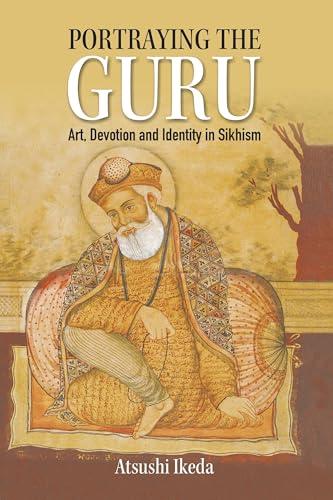
Portraying the Guru: Art, Devotion and Identity in Sikhism
Product Type: Bargain Books
Price:
List price: $144.00
Available: 1
Quantity:
copies bought in the last week
About
Brings to light the evolution of Sikh art from the eighteenth to the twentieth century.
Breaking fresh ground in the study of Sikh art, after the pioneering contributions of W.H. McLeod and B.N. Goswamy, this book on Sikh art evolution is centred on portraits of Sikh Gurus from the eighteenth to the twentieth century. It examines around two hundred and fifty texts of art, of various mediums, scattered across museums and private collections the world over. Ikeda artfully proves how Guru Nanak's portraiture catered to the spiritual and cultural needs not only of ordinary Sikhs, but also satisfied the expectations of the newly formed urban middle class.
Including critical review of Harjot Oberoi's study and emphasizing the significant role of Sikh art in the formation of a distinct Sikh community's identity, the author takes note of how the Singh Sabha Movement (1873-1909) and the Akali Movement of 1920 onwards popularized devotional portraits of Guru Nanak even though idolatry is forbidden in the sacred text Guru Granth Sahib. It underlines how there was a paradigm shift in the mentality of Sikh society under the colonial impact of the British Raj.
This highly illustrated volume will not only be appreciated by students of visual arts, researchers and academics, but also by the universities across the world in which Sikh Studies are taught.
Breaking fresh ground in the study of Sikh art, after the pioneering contributions of W.H. McLeod and B.N. Goswamy, this book on Sikh art evolution is centred on portraits of Sikh Gurus from the eighteenth to the twentieth century. It examines around two hundred and fifty texts of art, of various mediums, scattered across museums and private collections the world over. Ikeda artfully proves how Guru Nanak's portraiture catered to the spiritual and cultural needs not only of ordinary Sikhs, but also satisfied the expectations of the newly formed urban middle class.
Including critical review of Harjot Oberoi's study and emphasizing the significant role of Sikh art in the formation of a distinct Sikh community's identity, the author takes note of how the Singh Sabha Movement (1873-1909) and the Akali Movement of 1920 onwards popularized devotional portraits of Guru Nanak even though idolatry is forbidden in the sacred text Guru Granth Sahib. It underlines how there was a paradigm shift in the mentality of Sikh society under the colonial impact of the British Raj.
This highly illustrated volume will not only be appreciated by students of visual arts, researchers and academics, but also by the universities across the world in which Sikh Studies are taught.
Info
ISBN: 9781837652389
Published Date: September 24, 2024
Publisher: Manohar Publishers & Distributors
Language: English
Page Count: 280
Size: 8.75" l x 5.75" w x 0.75" h